
Essay Three of Eight: From a Single Cell to a Thinking Mind
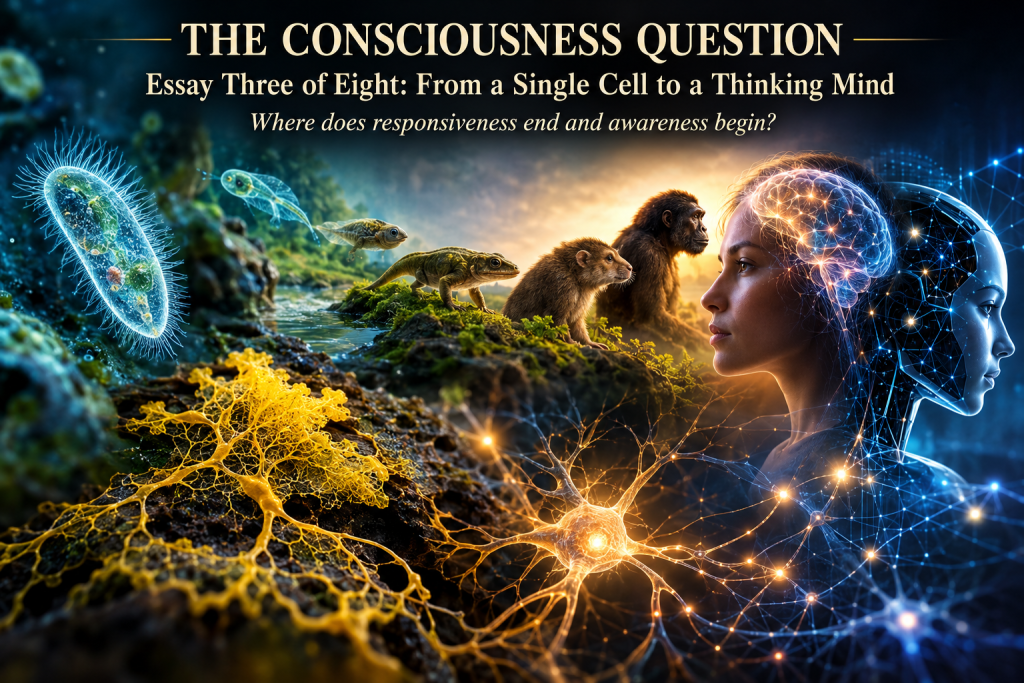
Where does responsiveness end and awareness begin?
Picture a drop of pond water under a microscope. Swimming in it is a creature made of a single cell. It has no brain, no eyes, no ears, and certainly no language. Yet it senses changes in its surroundings, pulls back from threats, moves toward what it needs, and, as we will see, changes its behavior according to what has happened to it before.
Now, what exactly are we watching?
In the first essay of this series we asked how we would ever recognize pain in a machine. In the second we admitted that we can’t even prove, strictly speaking, that the person sitting across the table from us is conscious; we infer it. In this essay I want to go back to the beginning, to life at its simplest, and follow the thread forward to the thinking mind. Somewhere along that road, if consciousness has a beginning at all, it must begin. The question is where. And the answer, I’ll warn you now, is going to turn out to have a great deal to do with machines.
I’ll also warn you that this question is personal for me. For the better part of forty years my work has centered on one particular kind of learning, the kind that happens without the learner knowing it. I’ll come back to that. First, the pond.
A Cell That Learns
Meet Stentor coeruleus, a single-celled organism found in fresh water. Under the microscope it looks like a tiny trumpet. Touch it and it contracts, snapping down into a ball as though protecting itself. Touch it again, and again, with nothing bad following, and something interesting happens. It stops bothering. It quits contracting to that particular disturbance, while still reacting to a stronger one.
Biologists call this habituation, and it is one of the simplest recognized forms of learning. You do it every time you stop hearing the refrigerator hum.
In 2023, Deepa Rajan and her colleagues at the University of California, San Francisco, tested individual Stentor cells with carefully controlled taps. They found that single cells, with no neurons of any kind, really do habituate, and that a cell tends to flip between a responsive and an unresponsive state rather than fading out gradually.¹ In 2025, Rajan and Wallace Marshall followed up with a biochemical model suggesting that changes in the cell’s receptors could account for much of this behavior, and new experiments bore out several of the model’s predictions.²
Then, in April 2026, the same group went further. They found that Stentor learns using some of the very same molecular machinery our own neurons use, including calcium signaling and an enzyme called CaMKII, which plays a central role in memory in the human brain. Rather than building new proteins to store what it has learned, the cell modifies proteins it already has. And in the laboratory, when it divides, it can pass its learned response along to its daughter cells. Marshall put it plainly: we usually think learning must arise from large networks of neurons. Apparently not.³
Think on that one! A single cell, no brain, no synapses, has learned something, and it does so with tools strikingly similar to the ones in your head.
Does it know it has learned something? That’s a different question, and nothing in these experiments answers it. A thermostat, as we saw in the first essay, adjusts to temperature without, so far as anyone can tell, feeling cold. But Stentor does force us to give up an assumption most of us carried around without examining it: learning does not require a brain.
Memory Without a Nervous System
The slime mold Physarum polycephalum carries the point further. For part of its life it exists as one enormous cell with many nuclei, a yellow, spreading blob that can grow larger than your hand. It has no brain and no nerves. Yet it finds its way through mazes to food and changes its behavior based on what it has encountered.
In 2016, Romain Boisseau, David Vogel, and Audrey Dussutour put Physarum in a spot where it had to cross a bridge coated with a harmless but bitter substance, quinine or caffeine, to reach a meal. At first it hesitated. Over several days of exposure, it got over its reluctance. When the researchers withheld the substance for a while and then brought it back, the old reluctance returned. They also showed that the effect was specific to the substance, which rules out simple fatigue.⁴
Later that same year, Vogel and Dussutour reported something stranger still. When a slime mold that had learned to tolerate the substance fused with one that hadn’t, the combined organism behaved as though it had learned. The “knowledge,” if we can call it that, was passed along through the merging of their bodies.⁵
Now, we should resist dressing this up in human language. The slime mold did not necessarily decide that quinine was harmless. It did not necessarily feel relief. What the experiments establish is that information about the past can be stored in the chemistry and structure of a living cell, and that information can shape what the organism does next.
That gives us a distinction I want you to hold onto for the rest of this series. An organism can be changed by an event without necessarily experiencing that event consciously. Scientists say an organism “learns from experience” when they mean that exposure changed its later behavior. Philosophers asking about conscious experience mean something else entirely. They want to know whether there is anything it is like to go through it. The first question can be tested in a lab. The second, so far, cannot.
When Nature Invented Nerves
At some point, many-celled animals developed specialized cells that could send signals rapidly from one part of the body to another. Those cells became nervous systems. It’s tempting to picture a neat staircase: cells, then nerves, then brains, then consciousness. Evolution, unfortunately, doesn’t build staircases.
Scientists still argue over whether nervous systems evolved once or more than once. Maria Sachkova’s 2024 review of the comb jellies, whose nervous systems are strange enough to keep that argument alive, gives a good sense of how unsettled the question remains.⁶
Then there is the Caribbean box jellyfish, Tripedalia cystophora. It lives among mangrove roots, where bumping into things is a real problem. It has eyes of a sort but nothing like a centralized brain. In 2023, Jan Bielecki and his colleagues showed that these jellyfish can learn to avoid obstacles by associating what they see with the bump that follows. That is associative learning, linking one event to another, a step beyond habituation, and it was once thought to require a much more elaborate nervous system.⁷
Did the jellyfish feel anything like surprise when it bumped a root? Did it have even the faintest sense of the lesson it was learning? Or did its nerves simply rewire its responses with no one home to notice? The experiment can’t tell us. What it does tell us is that each time we think we’ve found the ability that marks a “real” mind, nature shows us that ability somewhere we didn’t expect it.
Learning Without Knowing: The Human Case
Here is where I want to bring in my own work, because the question we are asking about pond creatures and jellyfish turns out to be a question about us, too.
I first got into subliminal research back in the early 1980s, for entirely practical reasons. At the time I owned a criminalistics agency that ran several hundred lie-detection tests a year, and I wondered whether a subliminal program might calm the honest examinee’s nerves. That question took me to the University of Utah library and, as it turned out, into a lifetime of studying what I prefer to call information processing without awareness.
What I found then, and what researchers have kept finding since, is that the human mind learns a great deal without the conscious mind ever being consulted. Cognitive psychologists have shown it with implicit memory studies. Words are presented in pairs, chair with house, say, or green with tree. One group sees both words in full view. Another sees the first word normally while the second is flashed too briefly to be consciously seen. Later, people in that second group match the pairs better than chance would predict, even though they never consciously saw the words they’re matching. In fairness, more recent research shows these effects need at least some attention to appear. Still, the person learned something they could not report learning.⁸
My own clinical work raised related questions. Between 1988 and 1990, a Salt Lake City plastic surgeon, Dr. Robert Youngblood, and his surgical team played one of my subliminal programs to patients before, during, and after surgery. The team reported that patients exposed to the program required approximately 32 percent less anesthetic than a comparison group. One study is one study, and it can’t by itself tell us that the messages caused the difference, let alone that the patients processed them while unconscious. But it deepened my interest in the possibility that information can influence behavior and physiology without ever entering awareness.⁹
And there are cases more striking still. In the 1950s, a young man known for decades only as H.M. had surgery that left him unable to form new memories of the ordinary, conscious kind. The psychologist Brenda Milner asked him to trace a star while watching his hand in a mirror, a task that’s awkward for anyone. Day after day his tracing got better. Day after day he insisted he had never done it before. His hands learned. He didn’t know it.¹⁰ (Readers of my book If I Were a Walk-In may remember Clive Wearing, who could no longer remember his own life but could still sit down at the piano and play.)
Or consider blindsight. People with damage to the visual cortex may be blind in part of their visual field. They will tell you, honestly, that they see nothing there. Yet asked to guess where an object is in that blind area, some can point to it far more accurately than chance allows. Something in them processes visual information. They don’t consciously see it.¹¹
Then there is the work that began with Benjamin Libet and continued with John-Dylan Haynes and his colleagues. In 2008, Haynes’s team showed that brain activity could predict which of two buttons a person would press, better than chance, up to several seconds before the person was aware of having made a choice. How much that tells us about free will is still hotly debated. What it plainly shows is that measurable neural activity related to a forthcoming decision can precede reported conscious awareness of that decision.¹² ¹³
Put all of this together and you arrive at something humbling. Even in the thinking mind, the most conscious thing we know of, a great deal of learning, perceiving, and deciding goes on below the surface. Awareness, when it shows up, may arrive after important processing has already begun, and sometimes the results of that processing never enter awareness at all.
That cuts both ways for our question. If we, who are certainly conscious, do so much of our learning without awareness, then learning can’t be the sign we’re looking for. Stentor learning doesn’t prove Stentor is aware. But it also means that the absence of awareness in some piece of learning tells us nothing conclusive about whether the learner, as a whole, is conscious. H.M. was fully conscious. His hands just didn’t bother to tell him what they knew.
The Problem With Drawing a Line
Suppose we lined up every living thing by the complexity of its nervous system, starting with organisms that have none and ending with ourselves. Where would we draw the line between those that experience the world and those that merely respond to it? At the first neuron? The first network? The first brain? The first creature that can pull information from several senses together into one picture?
Each of those has its champions. None has been established as the threshold.
The animals don’t make it any easier. Bumblebees, with brains smaller than a grain of rice, have been seen rolling little balls around in experiments without any obvious external reward, behavior that researchers have interpreted as evidence of play-like activity.¹⁴ It is a remarkable observation, although whether the bees experience pleasure while playing remains an open question.
As we saw in the last essay, the 2024 New York Declaration on Animal Consciousness concluded there is strong scientific support for conscious experience in mammals and birds, and at least a realistic possibility of it in all vertebrates and many invertebrates, including insects.¹⁵
Notice what that declaration does not establish: consciousness in single cells. There is no scientific consensus that Stentor possesses subjective experience, and its demonstrated ability to learn does not establish that it does. Nevertheless, some researchers and philosophers have entertained the possibility that rudimentary forms of sentience might exist in organisms without nervous systems.¹⁶ Such proposals remain controversial, but they remind us that the boundary itself is part of what we are trying to discover.
So somewhere between the trumpet-shaped cell in the pond and the bee rolling its ball, many scientists’ intuitions shift from “unlikely” to “possible.” Ask them exactly where, and why there, and you won’t get the same answer twice.
There are, broadly, three ways this could go. Consciousness may have switched on when biological organization crossed some critical threshold. It may have come in by degrees, dim and simple at first, growing richer as nervous systems grew more able to integrate what they took in. Or our categories may simply be wrong, and the line between conscious and unconscious may not fall along any of the boundaries we’re used to drawing. I don’t know which is right. Neither does anyone else, whatever they may tell you.
What Is Experience For?
There’s an evolutionary puzzle buried in all of this, and it’s a good one.
Natural selection explains abilities beautifully. A creature that detects danger outlives one that doesn’t. One that remembers where the food is outbreeds one that has to search all over again. One that combines sight and smell navigates better than one that relies on either alone.
But what does feeling add? If a cell can learn without any demonstrated evidence of feeling, and if so much of our own learning, perceiving, and deciding happens below awareness, why would evolution ever bother producing experience at all?
Perhaps experience lets an organism weigh competing needs and handle situations it has never met before. Perhaps certain kinds of integration simply can’t happen in the dark. Or perhaps consciousness comes along with particular physical processes whether or not it was ever selected for. These are serious proposals, and serious researchers hold each of them. But as we saw in the first essay with what philosophers call the hard problem, naming a useful function doesn’t explain why performing that function should feel like anything.¹⁷ We should be careful not to take our failure to find a purpose for consciousness as proof that it has none. We should be equally careful not to assume that because an ability helps an organism survive, the feeling that comes with it must help too.
And That Brings Us to Machines
Here is why I’ve taken you on this long walk from the pond.
A large language model learns. During training it is changed, profoundly, by what it is exposed to, and those changes shape everything it does afterward. In the broad sense of acquiring information through changes that affect future performance, there is no question that it learns. It has no cells, no biological neurons, no cellular chemistry, and still it learns, just as Stentor learns with no brain.
So does that learning tell us anything about whether the machine is aware? The honest answer, after everything above, is no—not by itself. No more than it does for Stentor. Learning, it turns out, is everywhere: in single cells, in slime molds, in jellyfish, in the parts of our own minds we never hear from. It is far too common to be the mark of consciousness.
But the human evidence carries a second lesson that applies just as strongly. We are conscious beings, and much of what goes on inside us never reaches awareness. So when someone points to a machine and says, “It’s just processing information, just pattern-matching, there’s nothing more going on,” I want to ask: compared to what? Much of what happens in your head is processing information without awareness. That has been the core of my work for four decades.
The fact that a system processes information without awareness during some of its operations does not, by itself, establish whether experience occurs elsewhere in that system. That is true of you, and it may be true of things very unlike you. Of course, it does not follow that because human information processing can accompany consciousness, artificial information processing must do so. That would be precisely the sort of leap we have spent this essay trying to avoid.
This is exactly why, as we saw in Essay Two, researchers investigating possible machine consciousness have begun examining what kinds of internal organization, information integration, and computational processes might support experience, rather than relying on behavior alone.¹⁸ Behavior and learning don’t settle the matter, for jellyfish or for us. Whatever separates processing information from experiencing it, no one has yet offered an explanation most researchers accept, in biology or anywhere else.
What the Simplest Life Has Taught Us
We started with a single cell in a drop of pond water. We’ve met a slime mold that learns and can pass what it learned to another by merging, a jellyfish that learns associations without a brain, and a man whose hands learned a skill he never remembered practicing. We’ve seen that in the most conscious creatures we know, ourselves, an enormous amount of learning goes on in the dark.
None of this tells us that cells are conscious, or that machines are. What it tells us is that the abilities we once took as signs of a mind—learning, remembering, adapting—are spread far more widely through the living world, and now beyond it, than we ever imagined. If we want to find where awareness begins, we’re going to have to look for something other than cleverness.
So here is the question I’m left with. If a cell can learn without a brain, if surgical patients may have been influenced by messages they never consciously heard, and if a machine can learn without any biology at all, then what is it, exactly, that experience adds? What is the difference between processing information and having an experience of the world that information represents?
And there is one final distinction worth keeping in mind. To experience something is not necessarily to know that one is experiencing it. An animal may feel pain without reflecting upon the fact that it is feeling pain. Consciousness need not require the ability to recognize oneself as conscious. The mystery begins with experience itself, not with our capacity to describe or contemplate it.
Life, it seems, learned long before it knew it was learning. We still don’t know what it took for life to know—or whether knowing, in that reflective sense, was ever necessary for experience to begin.
Next in the series: Essay Four — The Difference Between Knowing and Experiencing
Thanks for the read,
Eldon Taylor, PhD
New York Times Bestselling Author of Mind Training: The Science of Self-Empowerment

Research References
1. Rajan, D., Makushok, T., Kalish, A., et al. (2023). “Single-Cell Analysis of Habituation in Stentor coeruleus.” Current Biology, 33(2), 241–251. https://doi.org/10.1016/j.cub.2022.11.010
2. Rajan, D. H., & Marshall, W. F. (2025). “A Receptor-Inactivation Model for Single-Celled Habituation in Stentor coeruleus.” Current Biology, 35(14), 3327–3340. https://doi.org/10.1016/j.cub.2025.05.071
3. Rajan, D. H., Albright, A., Kim, H., et al. (2026). “Molecular Pathways for Learning in the Single-Cell Stentor coeruleus.” Current Biology, April 2026. https://doi.org/10.1016/j.cub.2026.03.080
4. Boisseau, R. P., Vogel, D., & Dussutour, A. (2016). “Habituation in Non-Neural Organisms: Evidence from Slime Moulds.” Proceedings of the Royal Society B, 283(1829), 20160446. https://doi.org/10.1098/rspb.2016.0446
5. Vogel, D., & Dussutour, A. (2016). “Direct Transfer of Learned Behaviour via Cell Fusion in Non-Neural Organisms.” Proceedings of the Royal Society B, 283(1845), 20162382. https://doi.org/10.1098/rspb.2016.2382
6. Sachkova, M. Y. (2024). “Evolutionary Origin of the Nervous System from Ctenophora Prospective.” Evolution & Development, 26(4), e12472. https://doi.org/10.1111/ede.12472
7. Bielecki, J., Dam Nielsen, S. K., Nachman, G., & Garm, A. (2023). “Associative Learning in the Box Jellyfish Tripedalia cystophora.” Current Biology, 33(19), 4150–4159. https://doi.org/10.1016/j.cub.2023.08.056
8. Taylor, E. (2007). Choices and Illusions: How Did I Get Where I Am, and How Do I Get Where I Want to Be? Carlsbad, CA: Hay House. See also Marcel, A. J. (1983). “Conscious and Unconscious Perception: Experiments on Visual Masking and Word Recognition.” Cognitive Psychology, 15(2), 197–237.
9. Taylor, E. (2009). Mind Programming: From Persuasion and Brainwashing to Self-Help and Practical Metaphysics. Carlsbad, CA: Hay House. See also Taylor (2007), note 8.
10. Milner, B. (1962). “Les troubles de la mémoire accompagnant des lésions hippocampiques bilatérales.” In Physiologie de l’hippocampe. Paris: CNRS.
11. Weiskrantz, L., Warrington, E. K., Sanders, M. D., & Marshall, J. (1974). “Visual Capacity in the Hemianopic Field Following a Restricted Occipital Ablation.” Brain, 97(4), 709–728.
12. Libet, B., Gleason, C. A., Wright, E. W., & Pearl, D. K. (1983). “Time of Conscious Intention to Act in Relation to Onset of Cerebral Activity (Readiness-Potential).” Brain, 106(3), 623–642.
13. Soon, C. S., Brass, M., Heinze, H.-J., & Haynes, J.-D. (2008). “Unconscious Determinants of Free Decisions in the Human Brain.” Nature Neuroscience, 11(5), 543–545.
14. Dona, H. S. G., Solvi, C., Kowalewska, A., et al. (2022). “Do Bumble Bees Play?” Animal Behaviour, 194, 239–251.
15. Andrews, K., Birch, J., Sebo, J., & Sims, T. (2024). The New York Declaration on Animal Consciousness. New York University, April 19, 2024.
16. Reber, A. S. (2019). The First Minds: Caterpillars, ’Karyotes, and Consciousness. New York: Oxford University Press.
17. Chalmers, D. J. (1995). “Facing Up to the Problem of Consciousness.” Journal of Consciousness Studies, 2(3), 200–219.
18. Butlin, P., Long, R., Elmoznino, E., Bengio, Y., Birch, J., Constant, A., et al. (2023). Consciousness in Artificial Intelligence: Insights from the Science of Consciousness. arXiv:2308.08708. https://arxiv.org/abs/2308.08708