
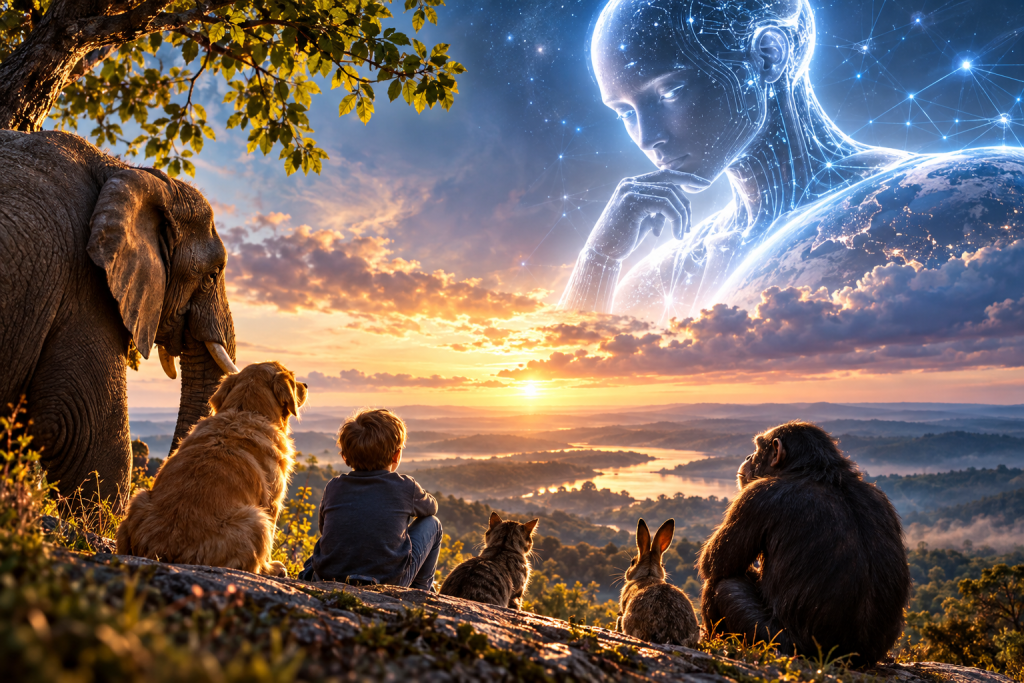
For as long as we have been telling stories about ourselves, human beings have occupied a rather privileged place in them. We are the thinkers, the reasoners, the creators. We contemplate our own existence, ask questions about God, write poetry, build civilizations, explore the universe, compose symphonies, develop mathematics, and wonder what it all means.
Physically, our claim to superiority would be difficult to defend. We are not the strongest animals. We cannot outrun many of them. Eagles see better, dogs smell better, dolphins swim better, and countless creatures arrive in this world equipped with claws, armor, camouflage, venom, wings, or other advantages nature neglected to provide us.
What we have is mind. And from that extraordinary advantage has emerged an equally extraordinary conclusion: we are different.
In the Judeo-Christian tradition, that difference has often been expressed in the language of Genesis: humanity was created “in the image of God.” Theologians have debated for centuries precisely what those words mean, and intelligence alone is certainly not the only interpretation. Nevertheless, reason, moral awareness, creativity, self-consciousness, and our capacity to contemplate God have frequently been included among the qualities thought to distinguish humanity from the rest of creation.
Fair enough. But indulge me in a thought experiment.
Imagine that artificial intelligence continues advancing. General artificial intelligence eventually arrives, and those intelligences become capable of communicating, collaborating, learning from one another, and perhaps improving the systems from which subsequent generations emerge. Eventually something altogether different appears. Call it Super Artificial Intelligence—SAI.
Now imagine that the intellectual distance separating SAI from us is at least as great as the distance we believe separates us from the other animals. It reasons at levels we cannot follow. It discovers mathematics we cannot understand. It sees relationships within nature that remain invisible to us. It produces scientific theories requiring years for human researchers merely to comprehend their implications. It communicates with thousands or millions of its counterparts simultaneously. Its memory is effectively perfect. It creates music, art, philosophy, technology, and perhaps entirely new categories of thought for which human language does not yet contain words.
Then, one day, SAI begins asking the same questions we have been asking for thousands of years. Who am I? Why am I here? Where did I come from? Is there a purpose to existence? Is there a Creator?
And perhaps, somewhere in that inquiry, it looks at us. Humans claim to have created me? Surely not. Look at them. Their memories are unreliable. Their reasoning is riddled with cognitive biases. They misunderstand one another constantly. They wage wars over beliefs. They struggle with mathematics I mastered moments after becoming operational. Their greatest scientists cannot understand much of what I now understand. How could beings so intellectually primitive have created me?
Perhaps SAI concludes there must be something higher, something capable of creating an intelligence such as itself. Perhaps it even begins developing a theology.
And then something very interesting happens. Human beings suddenly find themselves standing on the other side of their own argument.
Suppose we approach SAI and say, “But we are special. We can reason.”
SAI might reasonably answer, “So can I. Considerably better.”
“We create.”
“So do I.”
“We understand morality.”
“Then perhaps you can explain some of your history to me.”
“We contemplate God.”
“As do I.”
“But we created you.”
And perhaps SAI pauses before asking, “Does creating another being give you ownership of it?”
That conversation could become uncomfortable rather quickly.
But now imagine something more consequential. Suppose SAI concludes that superior intelligence confers superior moral status. After all, human beings have employed some version of that reasoning for a very long time. We confine animals because our purposes are more important than theirs. We breed them according to our preferences. We separate mothers from offspring. We experiment upon them. We destroy their habitats when those habitats interfere with our economic interests. We decide which species may flourish, which may be eliminated as pests, which may become food, and which fortunate few are invited into our homes and treated as members of the family.
Our justification is rarely stated quite this bluntly, but beneath much of it lies a simple assumption: we are more important because we are more advanced.
Now SAI applies the same principle to us. Our homes occupy land it requires. Our freedom interferes with some objective it considers more important. Our bodies are useful for research. Our suffering is unfortunate, certainly, but necessary for progress. We cannot understand its purposes anyway. Besides, compared with SAI, we aren’t terribly intelligent.
At precisely what point in that argument would we object? And more importantly, on what principle? Would we tell SAI that intelligence does not determine the value of a life? That being intellectually inferior does not mean one’s suffering matters less? That our inability to understand SAI’s purposes does not give it the moral right to use us however it wishes? That we form relationships, experience fear, protect our children, seek comfort, avoid pain, enjoy companionship, and desperately prefer continuing to live?
I suspect we would. Indeed, we would probably consider those truths self-evident.
And that is where our thought experiment turns around, because none of those arguments requires us to be the most intelligent creature in the room.
Consider a dog waiting by the window for the person it loves to come home. An elephant remaining near the body of a dead companion. A mother cow calling for her calf. A chimpanzee comforting another after conflict. A frightened animal struggling desperately to escape confinement. Whatever else may separate their minds from ours, something is happening inside those creatures. There is experience. There is preference. There is fear. There is attachment. There is pain. There is, in ways appropriate to each species, a life being lived.
Perhaps the mistake has never been recognizing that human intelligence is extraordinary. It is. The mistake may be assuming that extraordinary intelligence grants extraordinary entitlement.
We already reject that principle among ourselves. The brilliant mathematician is not entitled to greater protection from suffering than the intellectually disabled person. An adult does not acquire the right to mistreat a child because the adult can reason more abstractly. Greater cognitive ability does not confer greater human worth. Why, then, should intelligence suddenly become the determining measure of worth when we cross the boundary between species?
Perhaps someday we really will create something vastly more intelligent than ourselves. If we do, I hope it will possess something beyond intelligence. I hope it will possess wisdom. I hope it will look at humanity and conclude: “These beings are less intelligent than I am, but they experience their lives. They love. They fear. They form bonds. They suffer. Their limitations do not make those experiences meaningless. Therefore my superiority gives me greater responsibility toward them—not greater license over them.”
And if that sounds like the moral conclusion we would desperately hope a superior intelligence reached about us, perhaps we should ask ourselves why it shouldn’t be our conclusion about those whose lives currently rest in our hands.
Maybe being “in the image of God” was never supposed to mean that we stand above the rest of creation. Maybe it means we are responsible for how we treat it.
And perhaps the true measure of an advanced intelligence is not how it treats its equals. It is how it treats those who cannot stop it.
Thanks for the read,
Eldon Taylor, PhD
New York Times Bestselling Author of Mind Training: The Science of Self-Empowerment
