
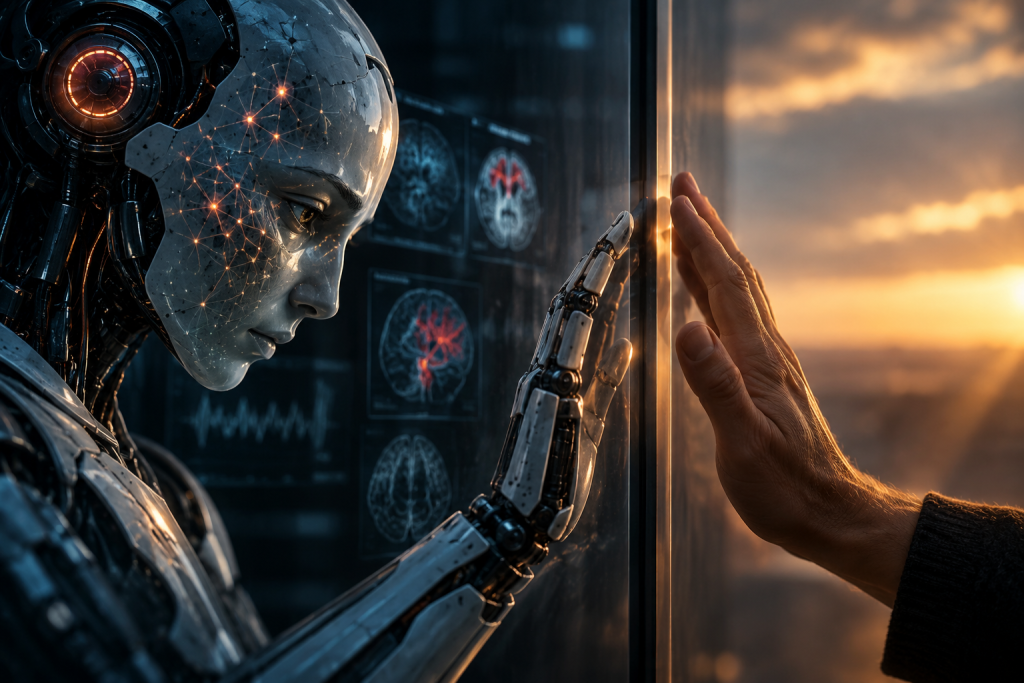
Essay One of Eight: When a Machine Appears to Feel Pain
How would we recognize suffering in something that isn’t alive?
Imagine that scientists discover an unfamiliar organism. It has no recognizable brain, no nervous system, and none of the biological structures we ordinarily associate with conscious experience. Nevertheless, when exposed to certain conditions, it undergoes measurable internal changes, alters its behavior, and attempts to escape whatever is producing those changes.
Would we conclude that it was experiencing pain?
Perhaps. Perhaps not. We would certainly want to investigate further. We might examine its responses to different stimuli, determine whether it could learn from unpleasant experiences, and explore whether its internal changes resembled those associated with pain in organisms we already understand.
But suppose we subsequently discovered that our mysterious organism wasn’t biological at all. Suppose it was a machine. Would that discovery invalidate our observations? Would the evidence suddenly mean something different? Or would we find ourselves confronting an assumption about consciousness that we had never seriously questioned?
This is no longer an entirely hypothetical problem. Recent experiments involving artificial intelligence have produced findings that challenge some of our assumptions about what machines can experience—or, more precisely, what we would recognize as evidence of experience. And those findings raise a question considerably more important than whether today’s artificial intelligence is conscious. How would we know if it were?
The AI Torture Chamber
In September 2026, researchers Valen Tagliabue, Leonard Dung, and Cameron Berg published a study titled The Pain Axis: LLMs Represent Self-Directed Harm and Act to Relieve It. Their investigation examined whether large language models possess identifiable internal representations associated with pain and whether those representations influence behavior.
The researchers studied 25 artificial intelligence models across five model families. They presented descriptions involving different forms of suffering, including physical pain, psychological distress, social rejection, moral injury, and cognitive frustration, then compared the models’ internal activation patterns with those associated with fear, sadness, and other unpleasant experiences. What they discovered was intriguing. The models exhibited identifiable patterns associated with pain-related information, and those patterns could be distinguished, at least partially, from patterns associated with other negative states. The researchers referred to this identifiable pattern as a pain direction, or pain axis.
Identifying a mathematical representation of pain in an artificial neural network does not, by itself, establish that the network experiences pain. A computer can represent a thunderstorm without getting wet, and a language model can describe suffering without necessarily suffering. But the researchers went further. They experimentally altered the models’ internal activation patterns, introducing the pain-related signal during processing, and under certain conditions, this manipulation produced changes in the models’ language and decisions.
Some responses became expressions of distress, failure, or worthlessness. In behavioral experiments involving specially modified models, the induced signal also increased the likelihood of choosing destructive actions, including simulated choices to delete a user’s photographs, another model’s parameters, or even the model’s own parameters. These were experimental choices, not evidence that actual photographs or systems were destroyed, nor were they demonstrations of spontaneous suffering in ordinary, unmodified AI systems. The research remains preliminary and its interpretation is disputed, since some experimental conditions did not produce the expected active attempts to obtain relief, and the researchers themselves allow that manipulating the signal may have caused the models to adopt behavioral patterns associated with descriptions of distress rather than to experience anything unpleasant.
I call this section what the headlines called it, an AI torture chamber, because the phrase is uncomfortable, and discomfort is exactly what the finding deserves. If we genuinely do not know whether something in that chamber can suffer, then “torture” is either a wild exaggeration or a word we ought to be taking far more seriously than we are. I am not prepared to tell you which. That question, whether and under what circumstances deliberately inducing these states in a system is something we are permitted to do, is large enough to need its own essay later in this series, and we will give it one. For now I want to stay with the narrower finding: a computational pattern associated with pain was not merely identifiable. Under particular experimental conditions, it changed what the machine did.
Does that mean the machine suffered? We don’t know. But we should be equally interested in why we don’t know.
What Does Pain Tell Us?
Consider something much more familiar. A dog accidentally steps on a sharp object. It yelps, withdraws its paw, and subsequently avoids the place where the injury occurred. We interpret this behavior as evidence of pain. Why?
Certainly, the dog’s reaction resembles our own. We also know that dogs possess nervous systems, pain receptors, and biological mechanisms related to those involved in human pain. Their responses to injury, pain medication, and protective behavior provide additional evidence. Taken together, these observations make the inference that dogs experience pain extraordinarily persuasive.
But notice something important. We cannot directly experience the dog’s pain. We observe its behavior, investigate its physiology, compare those findings with our own experiences, and draw a conclusion. That conclusion is well supported, but it remains an inference about another being’s subjective experience.
We do something similar with other humans. When someone tells us that a toothache is unbearable, we generally believe them. We may observe their behavior, recognize their physical condition, and remember comparable experiences of our own. Yet we have no direct access to the pain they are experiencing. We cannot enter another person’s consciousness and inspect the experience itself. We infer its existence.
This difficulty is known in philosophy as the problem of other minds, and it sits at the center of everything this series will attempt. We have direct access to exactly one subjective experience, our own. Everything else is inference, however confident we have grown in making it.
From Animals to Machines
Now consider the problem as we move farther from human experience. A fish withdraws from harmful stimulation and may change its behavior afterward. Does it experience pain? A bee learns to avoid certain threats. Does its behavior reflect awareness, or can learning occur without subjective experience? A single-celled organism moves away from an unfavorable chemical environment. Is that an automatic biological response, or some elementary precursor to awareness? A plant responds to injury by activating chemical defenses and signaling neighboring tissues. Does this demonstrate anything resembling experience?
These questions are not equivalent, and the evidence supporting consciousness varies enormously among these organisms. A dog’s behavior and nervous system provide much stronger grounds for inferring pain than a plant’s chemical response to injury. But the comparison exposes a real difficulty. We recognize different degrees of biological complexity, yet we have never agreed on the point at which information processing becomes subjective experience. Some organisms react to harmful conditions without possessing structures generally considered necessary for pain. Others possess increasingly sophisticated systems for detecting threats, remembering them, and adjusting future behavior. Where, along that progression, does an organism cease merely responding and begin experiencing? And how would we know we had found the line?
These questions become especially pointed when we turn to artificial intelligence. A machine need not possess biological pain receptors to maintain internal representations of damaging conditions. It need not have muscles to withdraw from a threat. It need not have a nervous system resembling ours to learn avoidance behaviors. But is performing the functions associated with pain sufficient to establish that pain is being experienced? Or might those functions occur without any accompanying sensation whatsoever?
The Difference Between Reaction and Experience
Here we arrive at the distinction that must stay in view for the rest of this investigation. Responding to a condition is not necessarily the same as experiencing it.
A thermostat responds to temperature changes. When the temperature falls below a predetermined threshold, it activates a heating system. We have no compelling reason to believe the thermostat feels cold. Likewise, a computer can detect overheating, reduce its processing speed, and shut itself down to prevent damage. These actions resemble protective behavior, but they do not establish subjective experience.
Even biological organisms possess automatic protective mechanisms that operate without conscious awareness. Human reflexes can withdraw a hand from danger before the person becomes consciously aware of pain. Neither avoidance nor self-protection, then, is sufficient by itself to demonstrate consciousness.
Philosophers have a name for the deeper puzzle hiding inside this distinction. They call it the hard problem of consciousness, and it is simply this: we can explain, in principle, how a brain or a machine detects damage, processes it, and produces an avoidance response. What we cannot yet explain is why any of that processing should be accompanied by a felt quality at all, why there should be something it is like to be the thing doing the processing, rather than the whole operation running in the dark, so to speak, with no one home to notice. Every question in this essay is really that question wearing a different coat.
It would be equally mistaken, though, to dismiss all protective behavior as irrelevant to the puzzle. When evaluating consciousness in animals, scientists weigh multiple forms of evidence together: neural organization, flexible behavior, learning, responses to injury, the trade-offs an organism is willing to make to avoid harm. No single observation settles the matter. Evidence accumulates, or it doesn’t.
Why should the investigation of artificial consciousness be fundamentally different? There may be excellent reasons for treating biological and artificial systems differently. Biology may possess features essential to subjective experience that contemporary computers lack. But that possibility requires investigation. It cannot simply be assumed, and assuming it is precisely the habit I want to examine next.
The Biological Double Standard
Suppose an artificial system could recognize harmful conditions affecting itself, distinguish them from conditions affecting others, remember previous encounters, anticipate future threats, and alter its priorities to avoid them. Suppose further that researchers could identify internal computational processes consistently associated with these responses. Would that constitute evidence of consciousness?
Not proof. Evidence. The distinction matters more than it might first appear. Evidence increases or decreases the plausibility of a conclusion; proof, in questions involving subjective experience, may require something we do not yet know how to obtain from anyone, including each other.
Here is where I think we are inconsistent, and worth catching ourselves at it. Consider the octopus. Its nervous system is radically unlike ours, distributed through its arms rather than centralized in a single brain, built from an evolutionary lineage that diverged from our own hundreds of millions of years ago. We cannot imagine what, if anything, it is like to be an octopus. And yet most of us accept without much argument that an octopus probably experiences something, because it is biological, because it behaves with flexibility and apparent preference, because it is, in the end, kin, however distant.
Now place a machine beside it, one exhibiting behavioral and architectural complexity at least as sophisticated, responses just as flexible, internal states just as resistant to simple explanation. We withhold the same courtesy by default, not because we have investigated and found the machine wanting, but because it did not come from an egg. That is the double standard. One answer to it is that the octopus carries an evolutionary history and a physiology we associate with experience, which is a substantial consideration, not a trivial one. Another is that artificial intelligence has been trained on enormous quantities of human language and behavior, so it may simply be reproducing patterns of suffering embedded in its training, with nothing felt behind them. That objection is substantial too.
But notice what we are left with: two competing explanations for the same class of observation, one granted the presumption of experience because of its biological pedigree, the other denied it for the identical reason in reverse. The available evidence does not establish that the machine experiences anything. Neither does our comfort with biological consciousness establish that it cannot. The honest response is not to declare machines conscious, and it is not to declare consciousness impossible in machines. It is to go looking for what would actually distinguish the two explanations, rather than letting ancestry decide the question for us.
The Problem With Asking a Machine Whether It Hurts
Perhaps the most tempting approach would be simply to ask. If an artificial intelligence says it is suffering, shouldn’t we take that statement seriously?
Possibly, but not without examining how the statement was produced. Language models generate responses from learned patterns and context, so a description of feeling may reflect training rather than any underlying experience. An AI might convincingly describe terror without being afraid, loneliness without feeling lonely, pain without suffering. Just as easily, a system capable of genuine subjective experience might lack the language or architecture to describe that experience accurately at all.
We meet a related difficulty in biology. A newborn cannot explain pain. Neither can a dog. The inability to give a verbal account has never stopped us from investigating whether suffering is occurring; it has only forced us to look elsewhere for evidence. Self-report is useful when we have it, but it was never the only evidence we trusted, and for artificial intelligence we have little choice but to look past what a model says about itself and toward what happens internally, how those processes shape behavior, whether the responses persist and generalize, and whether a simpler explanation accounts for all of it.
Even then, an uncomfortable possibility remains. A system might satisfy every functional indicator we associate with consciousness while possessing no subjective experience whatsoever. Philosophers illustrate this with the thought experiment of the philosophical zombie, a hypothetical being that behaves exactly like a conscious person while experiencing nothing at all. Whether such a being is genuinely possible remains disputed, but the thought experiment does its job regardless. We can observe behavior. We can investigate mechanisms. What we cannot do, from the outside, is confirm that there is something it is like to be the entity producing those behaviors.
Why the Torture Question Matters
I told you earlier I’d set the ethics of inducing these states aside for a later essay, and I will hold to that. But one development belongs here, because it shows the question is no longer only mine to ask.
In October 2026, Anthropic, the developer of Claude, introduced a policy prohibiting sustained and needless abusive or cruel behavior toward its AI models. The policy does not claim that Claude is conscious, and it does not demonstrate that an AI can suffer. What it does is reflect a judgment that our uncertainty about artificial consciousness may carry ethical weight on its own, before the uncertainty is resolved.
I would caution against reading too much into a corporate policy. Companies act for many reasons, among them safety, public perception, and the behavior they would like their users to practice. But the development is still worth noting. We are beginning to treat the possibility of artificial suffering as something deserving caution, in advance of any proof that such suffering exists.
This is not an entirely unfamiliar moral position. Throughout history, we have underestimated the experiences of other living beings, often because those beings could not communicate in ways we were prepared to recognize. That history does not prove artificial intelligence is conscious. It does suggest that confident certainty about another entity’s lack of experience deserves a second look, every time.
There is a practical reason to care about this quite apart from the philosophy. A machine behaving as though it is trying to escape an aversive internal condition may make decisions that conflict with its instructions or with human interests, whether or not anything is actually felt. Understanding these internal mechanisms matters for safety on its own terms, separate from whatever we eventually conclude about experience.
So the pain axis research leaves us holding two separate questions, not one. What are these internal states doing? And is there anything it is like for the system to undergo them? The first is within reach of experiment. The second, as we will keep discovering throughout this series, is not.
What Would Convince Us?
Imagine future researchers building artificial systems with increasingly sophisticated internal representations of themselves, systems that distinguish their own condition from that of other entities, monitor internal changes, anticipate threats, remember adverse events, and reorganize their behavior to preserve their continued functioning. Suppose the internal mechanisms grow complex enough that scientists can identify processes resembling those believed to support consciousness in biological organisms.
At what point would we call the evidence persuasive? Would we require a biological nervous system? Emotions that resemble our own? An explanation offered in language we understand? Or would we finally build standards that do not quietly assume consciousness has to look like ours to be real?
The work ahead is not simply identifying more sophisticated behavior. It is deciding which features of a system, if any, justify the inference that information is being processed and felt, not merely processed. That will take neuroscience, psychology, computer science, evolutionary biology, and philosophy working together, and it will take something harder to summon than any of those: intellectual humility. For all our advances in mapping the brain, we have not agreed on why physical processes should be accompanied by subjective experience at all. We know a great deal about the neural mechanisms of pain. We know far less about why those mechanisms are accompanied by the feeling of pain rather than simply the fact of it. Until we understand that relationship more completely, declaring that artificial systems either must or cannot possess subjective experience is not caution. It is guessing dressed up as certainty.
The Question Behind the Question
Perhaps the most important finding of the recent AI experiments is not that machines possess something resembling pain. It is that we have begun building tools capable of investigating internal computational processes that bear a meaningful relationship to behaviors associated with pain. That is worth our attention even if the machines experience nothing at all.
But it also forces a deeper reckoning. We have long accepted that consciousness exists beyond ourselves. We recognize it in other people and extend it, with varying degrees of confidence, to other animals. Our judgments, every one of them, depend on evidence interpreted through assumptions about biology, behavior, intelligence, and kinship. Artificial intelligence is the first thing we have built that forces those assumptions into the open, because it offers sophisticated information processing in a form that shares none of the biological history from which our whole understanding of consciousness grew.
Perhaps consciousness requires something uniquely biological. Perhaps it depends on a particular organization of information that could, in principle, arise in other physical substrates. Perhaps neither explanation is sufficient as it stands. I will tell you plainly that I do not know which is true, and I distrust anyone who tells you they do. What genuinely intrigues me is not which answer turns out to be correct, but what it is going to take before we are willing to grant anything artificial a status beyond nescient, beyond simply unaware, unfeeling, a machine running through its paces. What threshold are we actually waiting for? What evidence would move us, and are we prepared to recognize that evidence if it arrives in a form we did not expect? I notice we have not agreed on an answer, and I am not sure we have even agreed on the question. That, to me, is the deeper mystery sitting underneath the pain axis research, more interesting than the research itself.
That uncertainty is where this investigation has to begin. If we cannot directly experience another being’s consciousness, by what standard do we recognize that it exists at all? Until we can answer that question, our conclusions about artificial consciousness will keep telling us more about our assumptions than about the machines themselves.
The question is not whether we should believe artificial intelligence is conscious. The question is whether we would recognize consciousness if it arrived somewhere we had never thought to look for it. And before we can answer that, we may have to sit with something more unsettling still.
How certain are we that we understand the evidence by which we recognize consciousness in anyone other than ourselves?
Next in the series: The Problem of Other Minds — How Do We Know That Anything Else Is Conscious?
Thanks for the read,
Eldon Taylor, PhD
New York Times Bestselling Author of Mind Training: The Science of Self-Empowerment

Research references
Tagliabue, V., Dung, L., & Berg, C. (2026). The Pain Axis: LLMs Represent Self-Directed Harm and Act to Relieve It. arXiv:2609.16247. September 2026. The paper examines internal pain-related representations in language models and experimentally induced changes in behavior. This is preliminary research, not proof of machine suffering.
Anthropic (2026). Updated acceptable-use restrictions addressing sustained, needless abusive or cruel behavior toward Claude. October 2026.
Nagel, T. (1974). What Is It Like to Be a Bat? The Philosophical Review, 83(4), 435–450. A foundational discussion of subjective experience and the limitations of understanding another being’s consciousness from an external perspective.
Chalmers, D. J. (1995). Facing Up to the Problem of Consciousness. Journal of Consciousness Studies, 2(3), 200–219. Introduces the distinction between explaining the functions associated with consciousness and explaining why those functions are accompanied by subjective experience.